
For children who talk, but keep repeating
Vaakkshuddikaran Kwath Churna
Awareness · Understanding · Their own words. When a child echoes your questions, replays lines from cartoons or repeats the same movements again and again, the ability is usually there. Something is getting in the way. Vaakkshuddikaran is an Ayurvedic kwath made to help clear that block, prepared in our own GMP-certified unit and guided by Dr. Santhisree Bheesetti, Ayurvedic Child Neurocare Expert with 15+ years of experience.
- For echolalia, scripted speech, repeated questions and repetitive behaviours
- Works on awareness and understanding first, so the child's own words can follow
- A dual pack: a classical kwath (decoction) churna and a fine powder
- Free guidance from our doctors on whether it suits your child and how much to give
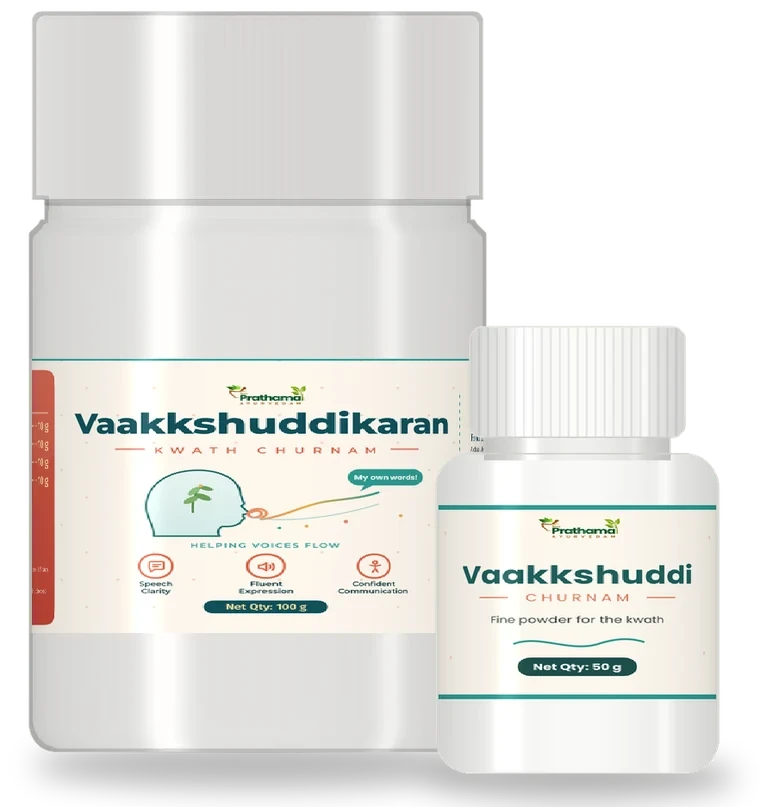
Dual pack
Vaakkshuddikaran Kwath Churna
Secure online payment. Delivered across India. Have a question first? WhatsApp us on +91 99897 59719. Our doctor guides the dose for each child.
Sound familiar?
"My child talks, but it isn’t real talking"
Parents tell us this almost every week. These are the patterns we see most often in the children this kwath is made for.
Echoing your words
You ask, "Do you want water?" and the answer comes back, "Do you want water?" This is called immediate echolalia.
Lines from cartoons and ads
A sentence heard days ago comes out at the dinner table, often word for word and in the same tone. This is delayed echolalia, also called scripting.
The same question, again and again
"Are we going to school? Are we going to school?" Even after you have answered it many times.
"You" instead of "I"
Saying "You want biscuit" when they mean "I want a biscuit", or finding it hard to answer a simple question directly.
Repeated movements
Flapping, spinning, rocking, lining up toys, switching a light on and off. Often the child doesn’t seem aware that they are doing it.
Stuck on routines
The same route, the same cup, the same order every time, and a meltdown if anything changes.
Repeating is not naughtiness, and it isn’t meaningless. Very often it is a child’s way of trying to communicate with the words they already have. Our aim is not to silence it, but to help your child move past it to words of their own.
The modern view
Why a child gets stuck in loops
Neuroscience has learnt a great deal about why children repeat. Here it is in three simple pictures.
- 1ThalamusSorts what the senses bring in
- 2InsulaFeels what is happening in the body
- 3Prefrontal cortexThe brakes: stop and change
- 4Basal gangliaWhere actions start, stop or repeat
- 5Wernicke’s areaUnderstands words
- 6Broca’s areaSpeaks words
- 7Arcuate fasciculusThe bridge between understanding and speaking
The filter: sorting what comes in
Think of a busy railway station. You hear the announcement, the fans, the traffic and people talking, and your brain quietly picks out what matters. In some children this sorting doesn’t work smoothly. Some sounds feel far too loud, or the important ones get missed. They may not feel their own body clearly either, like not noticing they are hungry, or bumping into things. (In the brain, this sorting happens in a part called the thalamus.)
The brakes: stopping and moving on
While we talk, the brain keeps pressing a gentle brake, so we can stop, listen and say something new. In many children who repeat, these brakes are weak. Once a word, a cartoon line or a hand movement starts, it keeps playing again and again, like a song stuck on repeat. Your child is not doing it on purpose. (Research links this to loops between the front of the brain and a deeper area called the basal ganglia.)
The bridge: from understanding to speaking
One part of the brain understands words. Another part speaks them. A bridge of nerve fibres joins the two. When messages cross this bridge slowly, it is hard for a child to build a new sentence of their own. So they reuse whole sentences they have already heard, like copying a ready-made answer. (This bridge is called the arcuate fasciculus.)
One more thing every parent should know: echoes are not meaningless. Often a child repeats a line because it is the only way they have to ask for something, calm down or stay close to you. So our goal is not to stop the echoes, but to help your child move on from them to words of their own.
The Ayurvedic view
Ayurveda saw the same picture
Ayurveda describes the mind and body through three forces: Vata, which moves; Pitta, which transforms; and Kapha, which holds and nourishes. Its explanation of repetition lines up closely with the modern one.
Tarpaka Kapha, the nourishing layer
A fine, protective form of Kapha in the head that nourishes the brain and every sense. In balance, it keeps the senses clear and steady. When it turns heavy and sticky, the child takes longer to understand, responds less, and loses track of their own body.
Covered Vata, the loop
Vata is the force that moves speech, thought and the body. When heavy Kapha covers it, a state Ayurveda calls Avarana, Vata can’t move forward. It goes round in circles instead, and words and movements come out in loops.
Udana and Vyana, voice and movement
Udana Vata carries a thought out as words. Vyana Vata plans movement and puts it in order. When both are trapped, the child replays what is already stored instead of creating something new.
Bodhaka Kapha, the speaking tongue
The Kapha of the tongue and mouth keeps them moist and responsive for clear speech. When it is heavy too, words can come out thick or unclear.
Ama, the sticky residue
When digestion is weak, food is not fully processed and a sticky residue called Ama builds up. Ayurveda sees Ama as the glue that thickens Kapha and blocks the channels of the mind.
Manovaha srotas, the channels of the mind
Ayurveda describes channels that carry the mind’s activity. When Kapha and Ama clog them, awareness, understanding and speech all slow down together.
Two languages, one child
Where Ayurveda and neuroscience meet
This is how we read the two side by side in our clinic. The links are our interpretation, meant to help parents and doctors see the same child from both sides. They do not claim that the two systems describe identical things.
| In Ayurveda | What it does | Closest idea in neuroscience |
|---|---|---|
| Tarpaka Kapha | Nourishes the brain and senses and keeps perception steady | Protective brain fluids and white matter (myelin); sensory filtering |
| Avarana | Heavy Kapha covers Vata, so movement and speech go in circles | Weak “brakes” in the loops between the frontal cortex and the basal ganglia |
| Udana Vata | Carries a thought out as words | Expressive language and the motor speech network |
| Prana Vata | Takes in and attends to what is heard and seen | Attention and auditory processing |
| Vyana Vata | Plans movement and puts it in order | Motor planning and sequencing |
| Sadhaka Pitta | Gives meaning and understanding | Comprehension and the brain’s meaning-making networks |
| Bodhaka Kapha | Keeps the tongue and mouth ready for speech | Oral-motor control for clear speech |
| Ama | The sticky residue of weak digestion | The gut–brain axis: gut microbes, immune signals and the vagus nerve |
| Manovaha srotas | The channels of the mind | Neural pathways and connectivity |
The 11 Functional Brain Systems Framework
Five brain systems this kwath works on
Dr. Santhisree Bheesetti’s framework looks at every child through eleven brain systems, each read through both neuroscience and Ayurveda. Vaakkshuddikaran works mainly on five of them.
Speech
- What you see
- Echoes, scripted lines and repeated questions; few sentences of their own.
- In the brain
- The bridge between understanding and speaking is slow, and the brakes on repeating are weak.
- In Ayurveda
- Udana Vata, which carries thought into words, is covered by heavy Kapha.
- How the kwath helps
- Clears that cover so Udana can flow, and the child begins building their own words.
Sensory processing
- What you see
- Over- or under-reacting to sound and touch; hardly noticing their own body.
- In the brain
- The brain’s filter for sounds and touch, and its sense of the body, are not working smoothly.
- In Ayurveda
- Tarpaka Kapha, which keeps the senses clear, has turned heavy.
- How the kwath helps
- Brings Tarpaka back into balance, so the senses clear and awareness returns.
Regulation
- What you see
- Flapping, spinning, rocking, and meltdowns when things change.
- In the brain
- The loops that start and stop a movement keep replaying the same one.
- In Ayurveda
- Vyana Vata, trapped under Kapha, keeps replaying the same movement.
- How the kwath helps
- Frees Vyana, so movements become calmer and more purposeful.
Executive function
- What you see
- Stuck on routines; finds it hard to shift from one thing to the next.
- In the brain
- The front of the brain, which helps us stop, change and plan, finds it hard to switch.
- In Ayurveda
- Rigidity is Kapha’s heaviness holding Vata in place.
- How the kwath helps
- Lightens that heaviness, so the child can shift more easily.
Gut–brain connection
- What you see
- Constipation, bloating, picky eating, a coated tongue.
- In the brain
- The gut and the brain talk to each other all day, through nerves and the blood. An unsettled gut can unsettle the brain too.
- In Ayurveda
- Weak digestion leaves Ama, which feeds the heaviness in the mind.
- How the kwath helps
- Its classical decoctions support digestion and clear Ama at the root.
What parents notice
First awareness, then words
Every child is different, and change takes time. In our clinic, it usually unfolds in this order.
What’s inside
Classical decoctions, chosen with care
Each 100 g of the kwath churna is prepared from equal parts of nine classical ingredients, made in our own GMP-certified unit in Kukatpally, Hyderabad.
Dashamula Kwath
Ten roots that calm Vata and steady the nervous system.
Patoladi and Rasnadi Kwath
Classical decoctions that clear Kapha and Ama and keep the channels open.
Vacha
The herb Ayurveda turns to for clearing Kapha from the pathways of speech and the mind.
Yashtimadhu
Soothing and nourishing, it balances the whole formula.
Apamarga, Nirgundi and Nagarmotha
Lighten Kapha and support digestion.
Amla
Cooling and rejuvenating, and gentle on a child’s gut.
The small bottle holds a fine powder that is stirred into the warm decoction just before your child drinks it.
How to give
One warm cup a day
It takes about fifteen minutes. Many parents make it in the morning while breakfast is cooking.
Best suited for children who
- Already speak, but repeat words, sentences or questions
- Depend on scripted lines from videos, songs or ads
- Talk a lot without stopping, or find it hard to pause
- Have repetitive movements or rigid routines
- Seem unaware of their own body or surroundings
Please keep in mind
- The dose and how long to give it are set by our doctor for each child
- Results vary from child to child
- Store in a cool, dry place, out of reach of children
- If your child is on other medicines, please tell our doctor first
Questions parents ask
Before you begin
Short answers to the questions we hear most. For anything else, WhatsApp us.
Is echolalia a bad sign?
No. Many young children echo while they learn to talk, and for many autistic children echoes are a real attempt to communicate. It is worth a closer look when repeating stays the main way a child talks after the toddler years, or gets in the way of daily life.
Will this stop my child from talking?
No. It doesn’t suppress speech. It works on awareness and understanding, so your child can move from repeated words to words of their own.
Is it only for speech?
No. The same blocked channels that cause echoed speech also drive repetitive movements and rigid routines, so it helps with those too.
How soon will we see a change?
It varies from child to child. Our doctor reviews your child’s progress at follow-ups and adjusts the plan as needed.
Does my child need a consultation?
We recommend one, so our doctor can check that it suits your child and set the right dose. You can start with a WhatsApp message, and we will guide you from there.
Read more
From our blog
If you would like to go deeper, these articles explain repetition and speech in more detail.
For doctors and researchers
The neuroscience on this page summarises current reviews. The links between Ayurveda and neuroscience are Dr. Santhisree Bheesetti’s clinical interpretation.
- Cohn EG, McVilly KR, Harrison MJ, Stiegler LN. Repeating purposefully: empowering educators with functional communication models of echolalia in Autism. Autism & Developmental Language Impairments. 2022. doi.org/10.1177/23969415221091928
- Soghomonian J-J. The cortico-striatal circuitry in autism-spectrum disorders: a balancing act. Frontiers in Cellular Neuroscience. 2024. doi.org/10.3389/fncel.2023.1329095
- Loureiro F, Ringold SM, Aziz-Zadeh L. Interoception in Autism: a narrative review of behavioral and neurobiological data. Psychology Research and Behavior Management. 2024. doi.org/10.2147/PRBM.S410605
- Microbiota gut–brain axis and Autism Spectrum Disorder: mechanisms and therapeutic perspectives. Nutrients. 2025. doi.org/10.3390/nu17182984
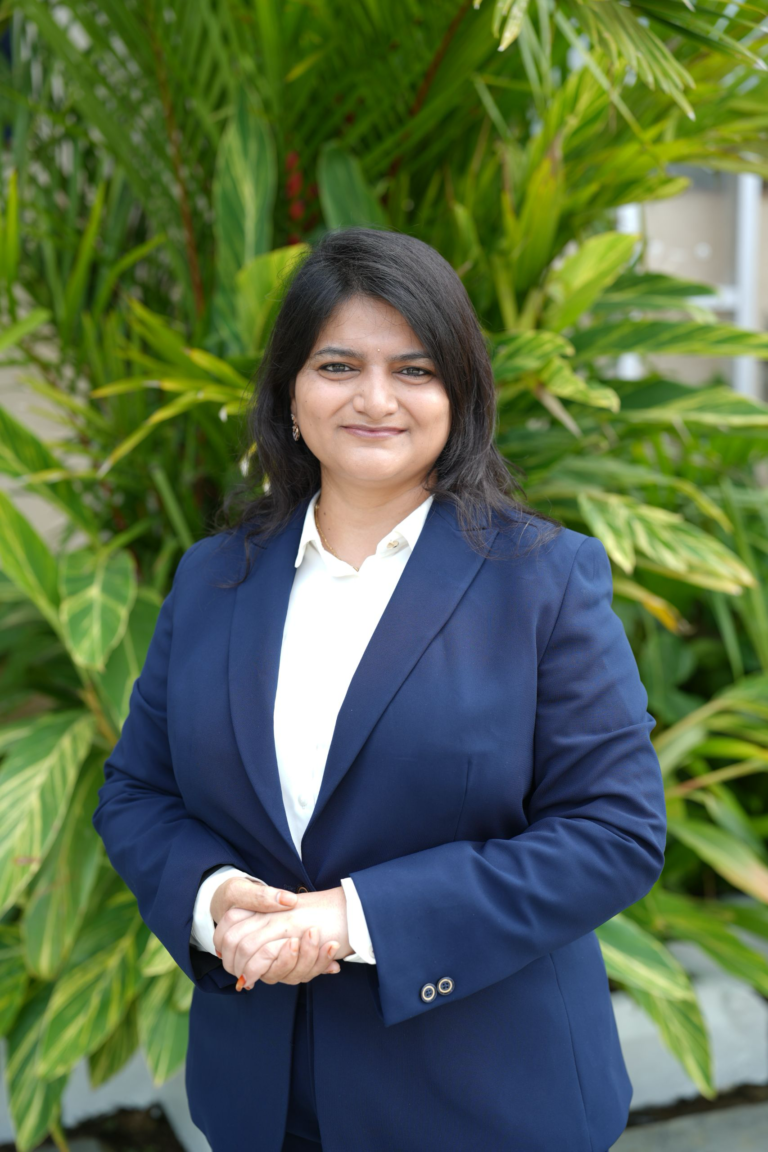
Meet the doctor
A mother first, a doctor next
"When I see a child, I think as a mother first and as a doctor next."
Dr. Santhisree had been practising since 2011 and had treated hundreds of children when her own son, at about 15 months of age, began losing words, eye contact and developmental milestones. Searching for answers, she began studying children far more deeply: their speech, behaviour, attention, sensory needs, sleep and digestion. Through Nadi Pariksha, she found that children with the same diagnosis often have completely different underlying imbalances, and with personalised medicines and Panchakarma, she saw remarkable changes in her son. Since then, she has dedicated her practice completely to children like him.
Founder & Chief Physician, Sree Prathama Ayurvedam
- B.A.M.S., Rajiv Gandhi University of Health Sciences (2010)
- 15+ years in paediatric neurodevelopment
- Developer of the Ayurveda Brain Type and the 11 Functional Brain Systems Framework
- Published research: IJMSIR, December 2024 (40 children)
- Cover story, Silicon India magazine
- International conferences in the USA and Bangkok
Recognition
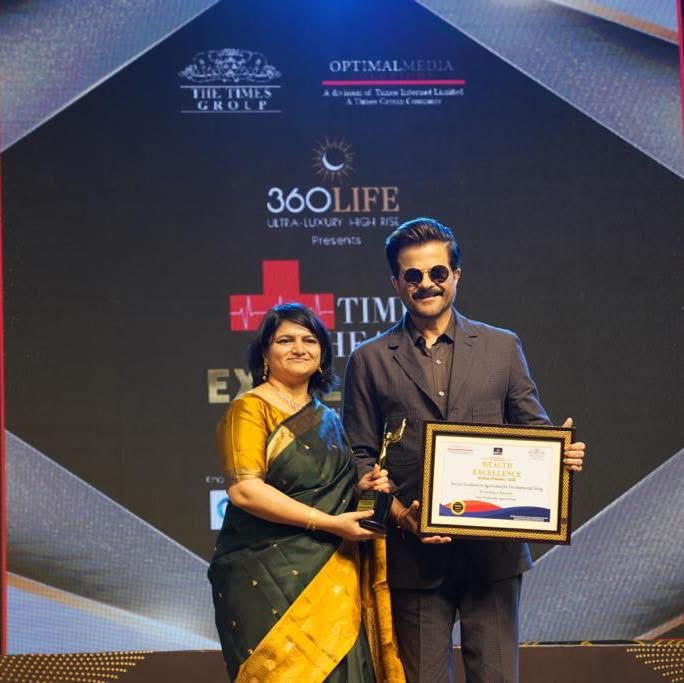
Times Health Excellence Award, two years in a row
Service Excellence in Ayurveda, Telangana & AP: for Developmental Delay in 2023, presented by Anil Kapoor, and for Autism & ADHD Care in 2024, presented by Sonali Bendre.

#DontWaitStartEarly
Don’t wait. Start early.
The sooner the channels clear, the easier it is for a child’s own words to grow. Talk to us about whether Vaakkshuddikaran suits your child.