
Speech delay › Echolalia
“I ask, ‘Do you want milk?’ and he says, ‘Do you want milk?’”
Speech & language family
Echolalia in Children
Your child repeats your question instead of answering it. Lines from a cartoon come back again and again, at home, in the car, at bedtime. Your child clearly has words, yet they don’t seem to be their own. This is called echolalia, where a child repeats words, phrases or sentences they have heard. Echolalia is not a lack of speech. Speech is there, but the child finds it hard to use it freely and with purpose. Dr. Santhisree Bheesetti, Ayurvedic Child Neurocare Expert with 15+ years of experience, supports children like yours, and their families, as they move from echoes to words of their own.

What parents often notice
Words are there, but they come back as echoes
Echolalia can look different from child to child. These are some of the things parents commonly describe.
Repeats your question instead of answering, like “Want biscuit?” for “Do you want a biscuit?”
Repeats lines from TV, videos or songs, sometimes hours or days later
Asks the same question again and again, even after you have answered
Says “you” when they mean “I”, as in “You want water”
Repeats more when excited, tired, anxious or in a new place
Has many words and phrases, but finds it hard to make their own sentences
Repeating words is a normal part of learning to talk, and noticing a few of these signs does not mean something is wrong. Only a proper assessment can tell what is going on, with us, a developmental paediatrician or a speech-language pathologist.
Two kinds of echoes
Right away, or much later
Professionals usually describe echolalia in two ways. Many children show both.
Repeating straight away
The child repeats what was just said, often in the same tone.
- “What is your name?” → “What is your name?”
- “Sit down” → “Sit down”, while sitting down
Sometimes this is the child’s way of saying “yes”, taking a turn, or buying time to understand.
Repeating later
The child repeats something heard earlier, from a person, a video or a song.
- An advertisement jingle at dinner time
- “Time for bath!” when they want water to play with
A delayed echo can carry a real meaning, if you look at when and where the child uses it.
Toddlers repeat words as they learn to talk, and this usually fades by around age 3.
Please have your child checked soon, by us, a developmental paediatrician or a speech-language pathologist, if your child:
- Is still mostly repeating, rather than making their own sentences, after age 3
- Rarely uses words of their own to ask for things
- Has lost words or skills they used before
- Rarely looks at you, responds to their name or points to show you things
- Repeats so much that it gets in the way of daily communication
- Is also behind in other areas, such as understanding, movement or play
A hearing test is also important.
Traditional Ayurvedic interpretation
Speech that is ready, but stuck in a loop
From an Ayurvedic perspective, echolalia is best understood not as an absence of speech, but as a difficulty in regulating speech. Udana Vata starts speech, gives it direction and helps a child stop and change what they are saying. In echolalia, Ayurveda most often sees Kapha, together with Ama, covering Udana Vata. Kapha is heavy, sticky and slow to change. When it blocks the path, the urge to speak is still there, but speech cannot flow freely, so it repeats. The problem is regulation, not stimulation.
Kapha–Ama Avarana of Udana Vata
When heavy Kapha and Ama block the flow of speech
- Repeats the same words or questions, and finds it hard to stop or switch
- Likes sameness, and gets upset when routines change
- Slow to get going, or heavy and sleepy, especially in the morning
- Frequent colds, a blocked nose, or slow, heavy digestion
Care focus: clearing Ama and reducing Kapha first, so Udana Vata can move freely.
Prana–Udana Vata Vaishamya
When restless Vata keeps the loop running
- Repeating gets faster or louder with excitement, stress or tiredness
- Picks up lines from screens very quickly
- Light, broken sleep, and an active, restless body
- May be sensitive to noise, touch or crowds
Care focus: calming and grounding Vata, once the Kapha block is eased.
In our experience, Kapha is very often the main factor in children with echolalia, and many show a mix of both patterns. These are general patterns from traditional Ayurvedic interpretation, not a way to judge your own child. Through Nadi Pariksha, developmental history, clinical observation and assessment of digestion, sleep, sensory responses and behaviour, we develop an individualised Ayurvedic care plan.
Read Dr. Santhisree’s article on echolalia and speech regulation →
The 11 Functional Brain Systems Framework
Echoes touch many systems
Dr. Santhisree’s 11 Functional Brain Systems Framework looks at the whole child. These are the systems most closely linked to echolalia.
Not every child has difficulty in all of these. The assessment shows which systems need support in your child.
How we help
Clearing the path, so speech can flow
The goal is not to force speech or simply stop the echoes, but to restore balance, so that speech can come out more freely and with purpose, at your child’s own pace.
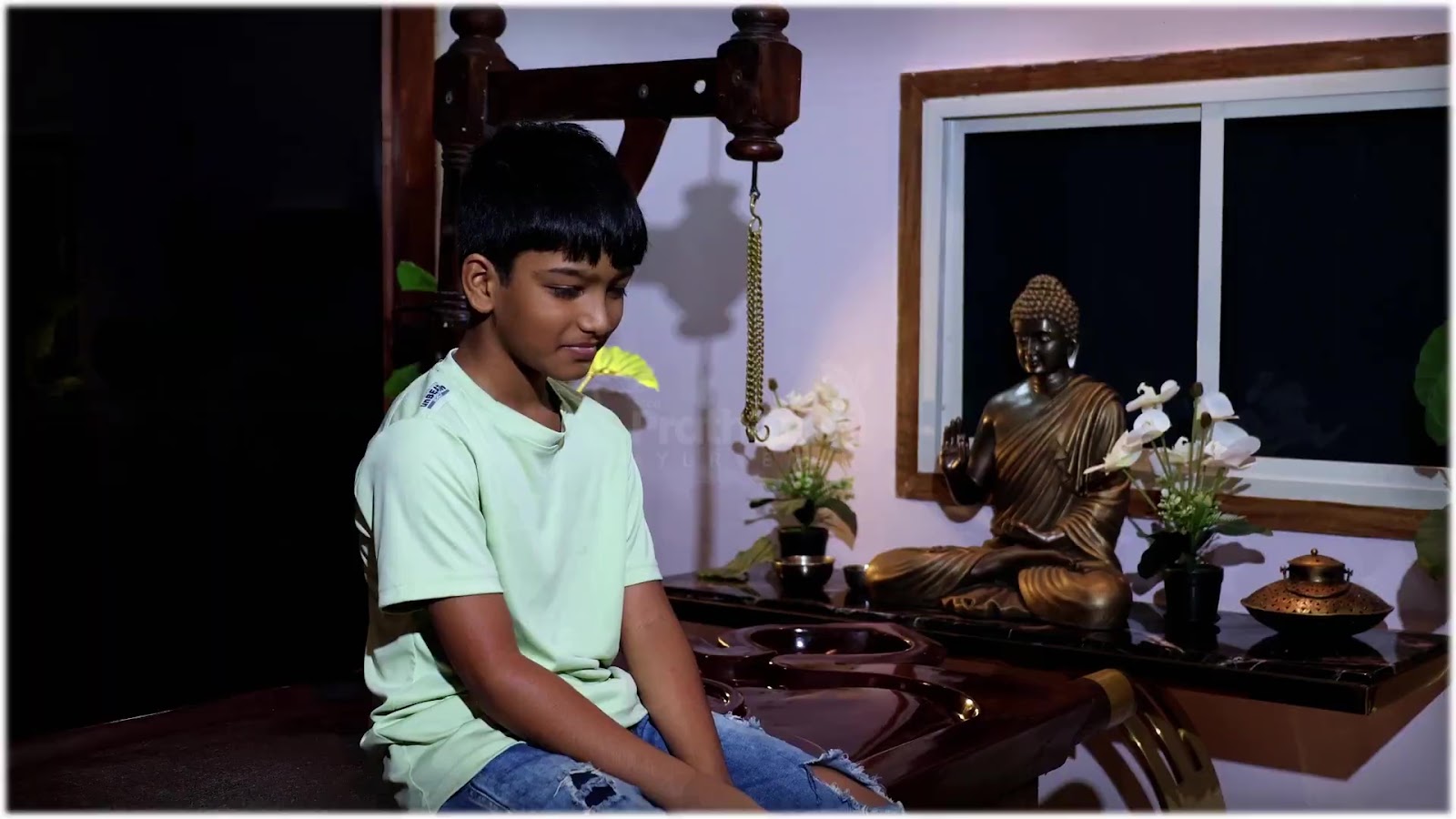

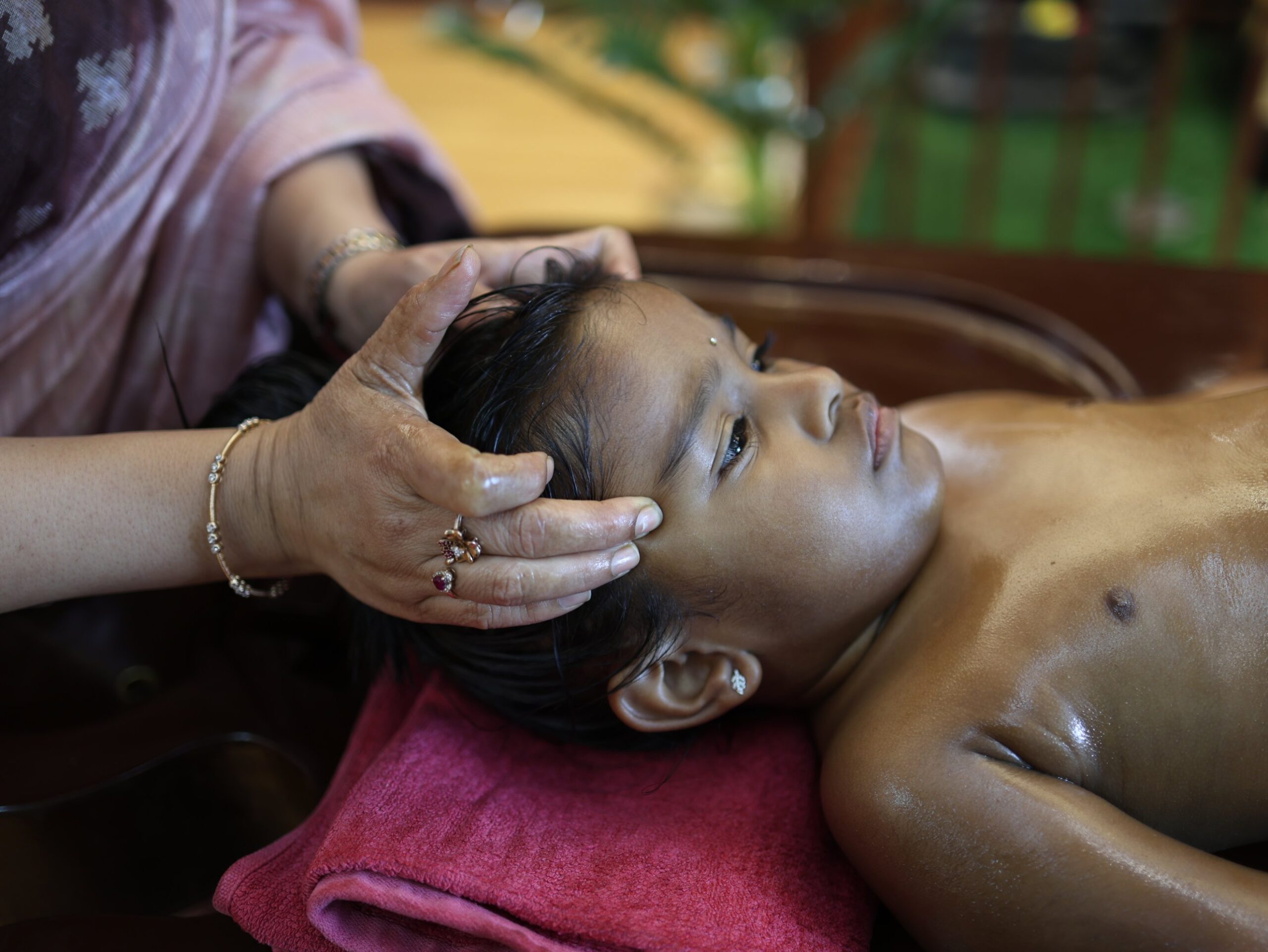
- Clearing Ama firstMedicines and simple food changes to improve digestion and clear Ama, the sticky residue that adds to Kapha.
- NasyaMedicated drops through the nose, which Ayurveda sees as the gateway to the head. Used to clear extra Kapha and free Udana Vata.
- Udvartana and SwedanaA massage with dry herbal powders, followed by gentle herbal steam, to reduce Kapha and Ama. Oil-based Abhyanga is usually kept for later, once the Kapha block has eased.
- VastiMedicated enemas, to balance Vata at its root once the Kapha block has eased.
- ShirodharaA steady stream on the forehead to calm a restless mind, when Vata is also high.
- Vaakkshuddikaran Kwath ChurnaOur Ayurvedic kwath, made in our own AYUSH-licensed unit, developed to support speech regulation in children with echolalia and scripted speech. Learn how it works.
- Customised medicinesMedicines with Medhya Rasayana herbs, chosen for your child’s pattern.
This page is for general information and is not a diagnosis. All therapies and medicines, including Vaakkshuddikaran Kwath Churna, are given only as advised by Dr. Santhisree Bheesetti after Nadi Pariksha. Not every child needs every therapy.
Assessment and follow-up
How we understand your child, and track progress
What we look at
- What your child repeats, and when and where it happens
- Whether echoes are immediate, delayed, or both
- Whether an echo seems to carry a meaning, like “yes” or “I want”
- How many sentences your child makes on their own
- How well they understand what is said to them
- Eye contact, pointing and response to their name
- Screen time, and where favourite scripts come from
- Hearing history and any earlier hearing tests
- Nadi Pariksha, along with digestion, sleep and behaviour
If needed, we may suggest a hearing test or an assessment by a developmental paediatrician or a speech-language pathologist.
What we watch for together
- Fewer repeated questions and scripts
- Answering a question instead of echoing it
- Saying “I” and “me” correctly
- New sentences of their own, even short ones
- Stopping and switching more easily
- Calmer days, better sleep and lighter digestion
Each child moves at their own pace. We note every small step, and adjust the plan as your child grows.
Start today at home
Six ways to help at home
Small changes in how you talk, play and eat together can help your child find their own words.
Look for the message
Notice when and where an echo comes. Respond to what your child may mean, not only to the words.
Say the words they need
Instead of asking a question that will be echoed, say the answer the way your child would say it.
Not “Do you want juice?” but “I want juice.”
Never scold the echo
Echoes often increase with stress. Stay calm and warm, and keep talking.
Fewer scripts from screens
Cut down screen time, and watch together when you can, talking about what you see.
Keep meals light and warm
Fresh, warm, home-cooked food suits a Kapha-heavy child. Go easy on cold, heavy and very sweet foods, especially at night.
Active mornings
Wake on time and start the day with active outdoor play. Ayurveda sees movement as one of the best ways to lift Kapha.
From research
What research tells us about echolalia
These studies are about how echolalia is understood in general. They are not studies of Ayurvedic treatment.
A 2022 review describes echolalia in typical development as well as in Autism and other conditions, and calls it a way of communicating.
A classic study of over 1,000 echoed utterances found seven different purposes, such as taking a turn, saying “yes” or asking for something.
A 2023 review of 15 studies on reducing echolalia found the research quality very low, and advised first trying to understand what the echoes mean.
- McFayden TC et al. Echolalia from a transdiagnostic perspective. Autism Dev Lang Impair. 2022. doi:10.1177/23969415221140464
- Prizant BM, Duchan JF. The functions of immediate echolalia in autistic children. J Speech Hear Disord. 1981. doi:10.1044/jshd.4603.241
- Blackburn C et al. A systematic review of interventions for echolalia in autistic children. Int J Lang Commun Disord. 2023. doi:10.1111/1460-6984.12931
Questions parents ask
Echolalia: your questions
Does echolalia mean my child has Autism?
Not always. Echolalia is common in Autism, but it is also part of normal language learning in toddlers, and can be seen in other conditions. If your child also makes little eye contact, rarely points or responds to their name, or plays in repetitive ways, please talk to us, a developmental paediatrician or a child psychologist about an Autism assessment. Read more about our Ayurvedic care for Autism.
Should I stop my child when they repeat?
No. Scolding or stopping the echo usually adds stress, and stress can increase repeating. It is better to understand what your child is trying to say, and to show them the words they need.
My child recites whole rhymes and adverts. Isn’t that good speech?
It shows that your child has a good memory and can produce speech. The next step is using words of their own, for their own needs. That is what we work towards.
Why does Ayurveda talk about Kapha and digestion for a speech problem?
Ayurveda sees Kapha and Ama as heavy and sticky. When they build up, Ayurveda understands that they can cover Udana Vata, which drives speech. That is why care often starts with digestion and lightening Kapha.
Can we consult from another city or country?
Yes. We offer online consultations across India and for families abroad. Medicines are currently delivered within India only.
Speech & language family
Other speech and language difficulties
These difficulties can occur independently or coexist. A comprehensive assessment helps identify the child’s individual communication profile.
#DontWaitStartEarly
Help your child find words of their own
Meet Dr. Santhisree Bheesetti at our clinics in Hyderabad, Visakhapatnam, Bengaluru or Delhi, or online from anywhere.