
Speech delay › Mixed language delay
“He doesn’t seem to follow what we say, and he hardly says anything back.”
Speech & language family
Mixed Receptive–Expressive Language Delay
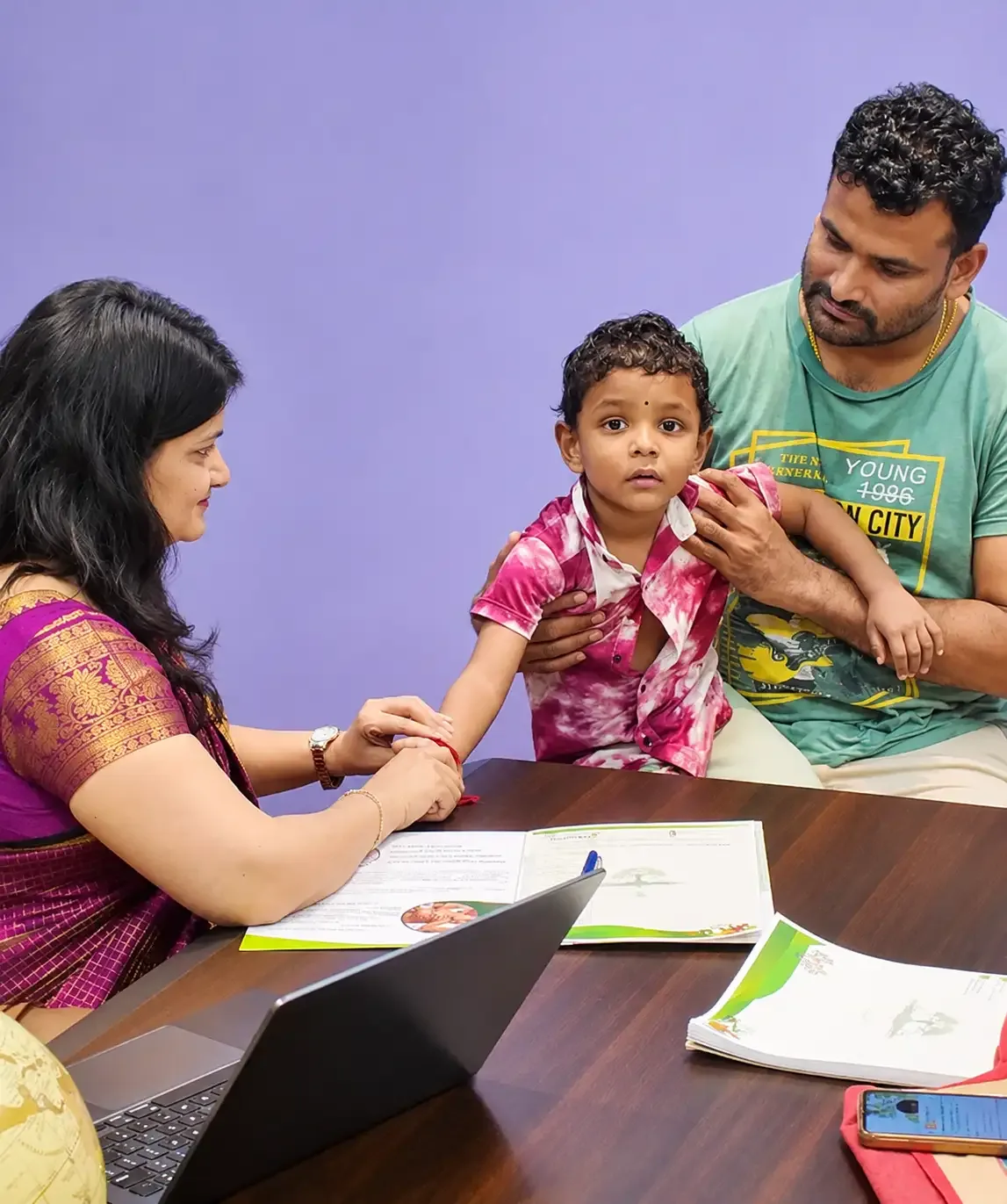
Your child is behind in more than talking. Simple instructions seem to pass them by, questions go unanswered, and words are few. You may find yourself guessing what they want, and they may find it hard to guess what you want. This may be a sign of mixed receptive–expressive language delay, where a child’s ability both to understand language and to express thoughts, needs and feelings develops more slowly than expected for their age. Dr. Santhisree Bheesetti, Ayurvedic Child Neurocare Expert with 15+ years of experience, supports children like yours, and their families, in building both sides of communication.
Signs parents often notice
Both sides of communication are slower
In mixed receptive–expressive language delay, both understanding and using language are behind what is expected for the child’s age. These are some of the things parents commonly notice.
Taking language in
- Follows instructions only with pointing, showing or routine
- Doesn’t point to familiar pictures or body parts when asked
- Answers questions in an unrelated way, or not at all
- Loses interest when stories or conversations go on
Giving language out
- Uses fewer words than other children of the same age
- Rarely joins words into short phrases
- Pulls your hand or cries, instead of asking
- Finds it hard to tell you what happened or what they want
Noticing a few of these signs does not mean your child has a language delay. Many of them overlap with hearing problems, Autism and other developmental difficulties. Only a proper assessment can tell what is going on, with us, a developmental paediatrician or a speech-language pathologist.
When to act
What most children understand and say
18 months
Follows a simple instruction without gestures, like giving you a toy when you say “Give it to me.”
SaysTries to say three or more words besides “mama” and “dada”.
2 years
Points to things in a book when asked, like “Where is the bear?”
SaysPuts two words together, like “more milk”.
3 years
Says what is happening in a picture when asked, like “eating” or “running”.
SaysHas a short conversation, with at least two back-and-forth turns.
Please have your child checked soon, by us, a developmental paediatrician or a speech-language pathologist, if your child:
- Is behind in both understanding and speaking for their age
- Does not respond well to sounds or to their name
- Uses very few gestures, like pointing, waving or nodding
- Has lost words or skills they used before
- Is also behind in other areas, such as movement or play
A hearing test is also important.
Milestones adapted from the CDC’s “Learn the Signs. Act Early.” programme.
Why it happens
What can hold back both sides of language?
Often there is no single cause. These are some of the things that may play a part, and more than one may be involved.
Hearing problems
Hearing loss, or fluid in the ears after repeated infections, affects both understanding and speaking.
Family history
Language difficulties often run in families.
Developmental language disorder
Some children have a lasting difficulty with language itself, with no other clear cause.
Linked developmental conditions
Mixed delay can be part of Autism, global developmental delay or other developmental difficulties.
Birth and early health
Being born early, low birth weight or a difficult start can add to the risk.
Traditional Ayurvedic interpretation
In traditional Ayurvedic interpretation, understanding and expressing language are linked to the functions of Prana Vata, Tarpaka Kapha, Sadhaka Pitta and Udana Vata, supported by Agni and Majja Dhatu. This is explained further down this page.
Traditional Ayurvedic interpretation
When the whole path needs support
From an Ayurvedic perspective, mixed receptive–expressive language difficulties may be interpreted through the functional relationship between Prana Vata, Tarpaka Kapha, Sadhaka Pitta and Udana Vata, along with the nourishment provided by Agni and Majja Dhatu. Unlike expressive or receptive delay alone, the difficulty is often spread along the whole path, from taking words in to giving them out. This is why care in mixed delay usually begins with the foundation: digestion, nourishment and balance.
Prana–Udana Vata Vaishamya
When Vata is unsettled along the whole path
- Attention moves quickly, and words don’t seem to settle in
- Few words, and effort to speak that comes and goes
- A light, restless child, sensitive to noise
- Dryness, constipation or light, broken sleep
Care focus: calming and grounding Vata, and nourishing Tarpaka Kapha and Majja Dhatu.
Kapha Avarana with Agni Mandya
When heavy Kapha and weak Agni slow the whole path
- Slow to respond, and seems to take longer to take words in
- Quiet, with little babbling or few attempts to talk
- Heavy or sleepy, and slow to get going
- Poor appetite or slow digestion, with frequent colds
Care focus: kindling Agni and clearing Kapha first, then nourishing the deeper tissues.
These are general patterns from traditional Ayurvedic interpretation, not a way to judge your own child. Many children show a mix of both. Through Nadi Pariksha, developmental history, clinical observation and assessment of digestion, sleep, sensory responses and behaviour, we develop an individualised Ayurvedic care plan.
The 11 Functional Brain Systems Framework
Many systems, working together
Dr. Santhisree’s 11 Functional Brain Systems Framework looks at the whole child. In mixed delay, several of these systems often need support at the same time.
Not every child has difficulty in all of these. The assessment shows which systems need support in your child.
How we help
Building from the foundation up
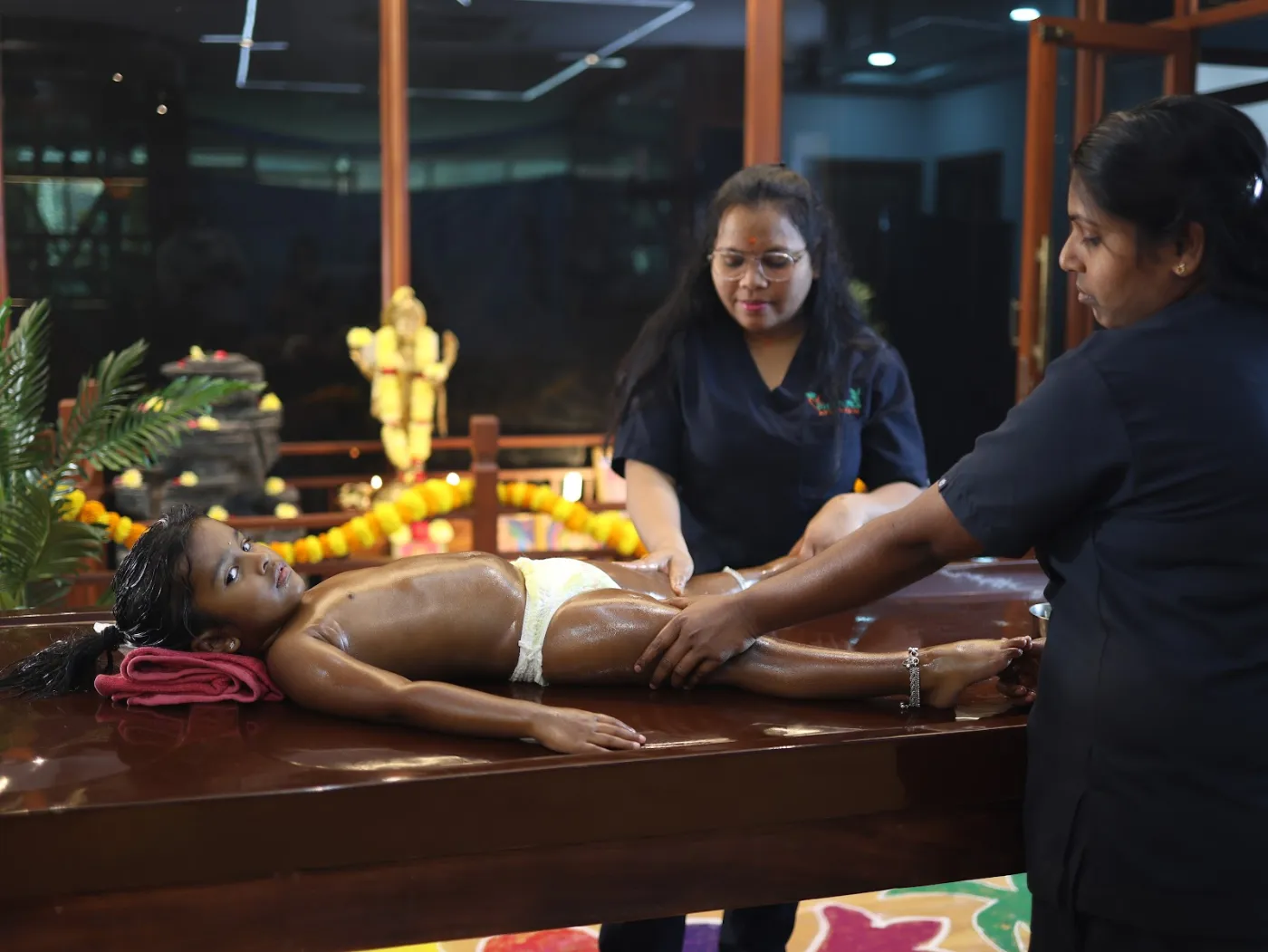

- Strengthening AgniMedicines and simple food changes to improve digestion and clear Ama, so that nourishment reaches every tissue.
- Abhyanga with MarmaMedicated oil massage with gentle Marma therapy, to calm Vata and nourish the body.
- Shiro Abhyanga and ThalamWarm oil or herbal paste on the head, to nourish Tarpaka Kapha and the senses.
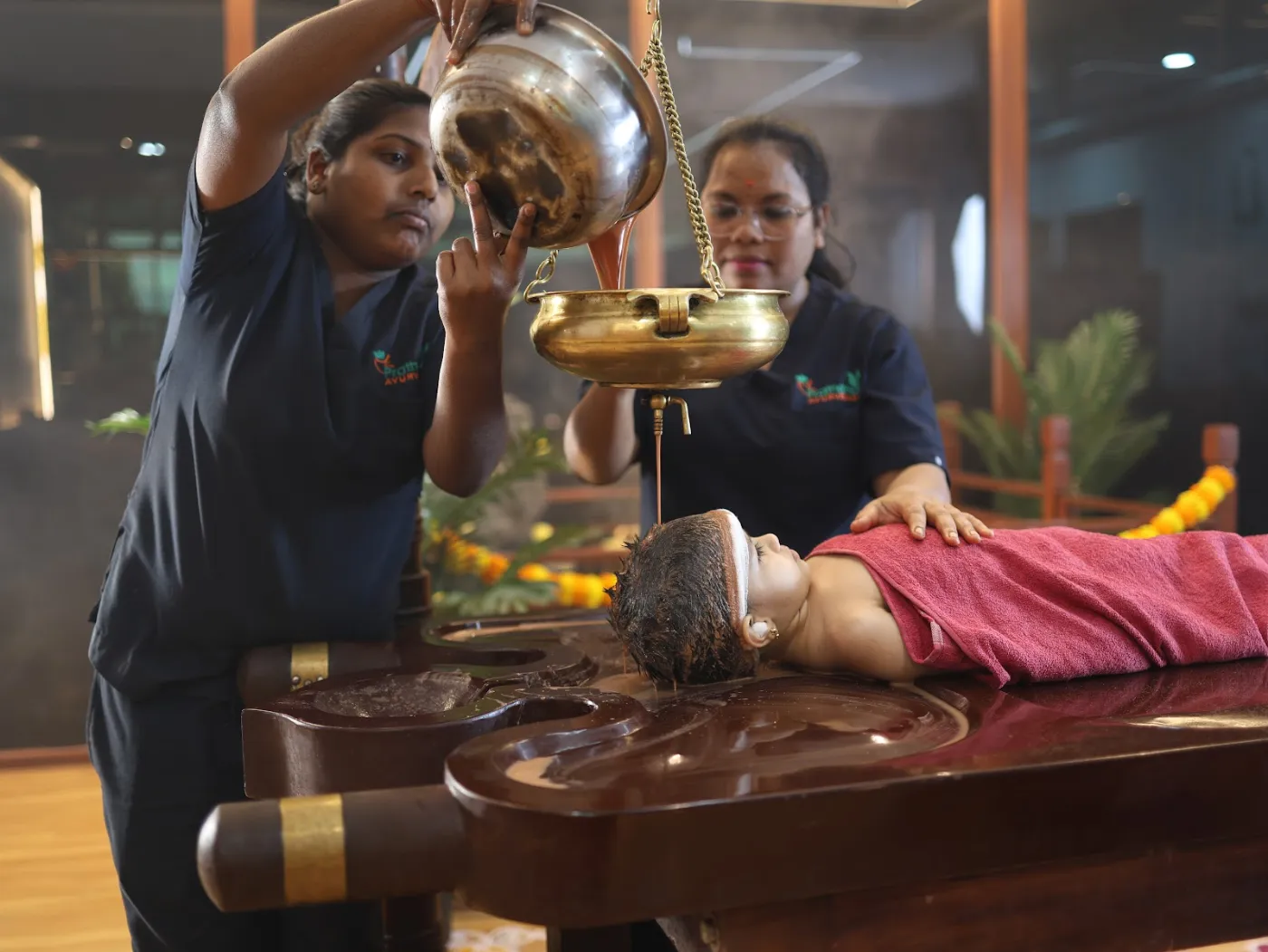
- Shirodhara or TakradharaA steady stream on the forehead, to settle the mind and support attention.
- NasyaMedicated drops through the nose, which Ayurveda sees as the gateway to the head, to support Prana and Udana Vata.
- VastiMedicated enemas, to balance Vata at its root and nourish Majja Dhatu.
- Customised medicinesMedicines made in our own AYUSH-licensed unit with Medhya Rasayana herbs, such as Vaakkdevi Rasayana, chosen for your child’s pattern.
This page is for general information and is not a diagnosis. All therapies and medicines are given only as advised by Dr. Santhisree Bheesetti after Nadi Pariksha. Not every child needs every therapy.
Assessment and follow-up
How we understand your child, and track progress
What we look at
- How your child responds to their name and to everyday sounds
- Which words, objects and instructions they understand
- How many words they use, and whether they join them
- How they communicate without words, through pointing and gestures
- Eye contact, play and interest in people
- Movement, play and other milestones
- Hearing history and any earlier hearing tests
- Nadi Pariksha, along with digestion, sleep and behaviour
If needed, we may suggest a hearing test or an assessment by a developmental paediatrician or a speech-language pathologist.
What we watch for together
- Responding more quickly when spoken to
- Following instructions without you pointing
- New words, and words used on their own
- More pointing, gestures and attempts to communicate
- Better appetite, digestion and sleep
- Understanding and talking in new places, not only at home
Each child moves at their own pace. We note every small step, and adjust the plan as your child grows.
Start today at home
Six ways to help at home
When both understanding and speaking need support, everyday routines become your child’s best classroom.
Same words, same routine
Use the same short words for daily routines, so your child learns what they mean and starts to use them.
“Shoes on. Bag. Go!”
Say it and show it
Point to or hold up the thing you are naming, every time.
Give time to respond
After you speak, wait a few seconds. Many children need extra time to understand and reply.
Talk about what they enjoy
Join your child’s play and name what they are looking at or doing.
Welcome every attempt
Respond warmly to pointing, gestures and sounds, not only to words.
Regular, warm meals
Fresh, warm meals at fixed times support Agni, the foundation of nourishment in Ayurveda.
From research
What research tells us about language difficulties
These studies are about language development in general. They are not studies of Ayurvedic treatment.
A study of over 7,000 school starters in England estimated that about two children in every class of 30 have a language disorder severe enough to affect learning.
In a study of late talkers, early scores in understanding language were among the best predictors of language difficulties at age 4, along with family history.
A 2024 clinical guideline advises that toddlers with delays in understanding as well as speaking should get specialised support, rather than only waiting.
- Norbury CF et al. The impact of nonverbal ability on prevalence and clinical presentation of language disorder: evidence from a population study. J Child Psychol Psychiatry. 2016. doi:10.1111/jcpp.12573
- Bishop DVM et al. Parental phonological memory contributes to prediction of outcome of late talkers from 20 months to 4 years. J Neurodev Disord. 2012. doi:10.1186/1866-1955-4-3
- Neumann K et al. Clinical practice guideline: interventions for developmental language delay and disorders. Dtsch Arztebl Int. 2024. doi:10.3238/arztebl.m2024.0004
Questions parents ask
Mixed delay: your questions
Is mixed delay more serious than a speech delay alone?
When understanding is also affected, difficulties are more likely to last without support. This is not a reason to worry, but a reason not to wait.
Could this be Autism?
Mixed delay can happen on its own. But if your child also makes little eye contact, rarely points or responds to their name, or plays in repetitive ways, please talk to us, a developmental paediatrician or a child psychologist about an Autism assessment. Read more about our Ayurvedic care for Autism.
Does my child have a learning problem?
Not necessarily. Many children with language delay have typical abilities in other areas. A full assessment helps separate language difficulties from wider developmental concerns.
Why does Ayurveda start with digestion?
In traditional Ayurvedic interpretation, Agni is the foundation of nourishment. When digestion is weak, the deeper tissues that support the senses and the mind are not fully nourished, so we often strengthen Agni first.
Can we consult from another city or country?
Yes. We offer online consultations across India and for families abroad. Medicines are currently delivered within India only.
Speech & language family
Other speech and language difficulties
These difficulties can occur independently or coexist. A comprehensive assessment helps identify the child’s individual communication profile.
#DontWaitStartEarly
Help your child understand and be understood
Meet Dr. Santhisree Bheesetti at our clinics in Hyderabad, Visakhapatnam, Bengaluru or Delhi, or online from anywhere.