
Speech delay › Receptive language delay
“My child hears me, but doesn’t seem to understand what I say.”
Speech & language family
Receptive Language Delay in Children
Your child hears you, and may even turn when you call. But when you say “Bring your shoes” or “Where is your nose?”, they look at you, do something else, or wait for you to show them. This may be a sign of receptive language delay, where a child’s ability to understand words, questions and instructions develops more slowly than expected for their age. Dr. Santhisree Bheesetti, Ayurvedic Child Neurocare Expert with 15+ years of experience, supports children like yours, and their families, as they learn to make sense of words.
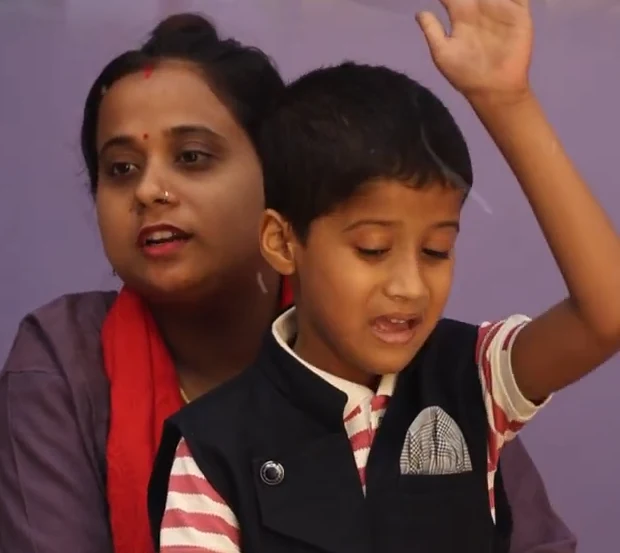
Signs parents often notice
Hearing the words, missing the meaning
Receptive language is how a child understands what others say. In predominantly receptive language delay, a child may find it harder than other children of the same age to understand words, questions and instructions, especially when there is no pointing or familiar routine to help.
Follows instructions only when you point, show, or when it is part of a daily routine
Finds two-step instructions hard, like “Pick up the cup and give it to Amma”
Doesn’t point to pictures or body parts when you ask
Gives an unrelated answer to a question, or repeats the question back
Seems to drift away or stop listening when you talk for long
Gets upset, or seems “naughty”, when they don’t understand what is expected
These signs can have many causes, including hearing problems and attention difficulties. Noticing a few of them does not mean your child has receptive language delay. Only a proper assessment can tell what is going on, with us, a developmental paediatrician or a speech-language pathologist.
When to act
What most children understand by this age
1 year
Understand “no”, pausing or stopping when you say it, and wave bye-bye.
Get your child checked ifYour child doesn’t seem to understand “no”, or doesn’t look when you call their name.
18 months
Follow a simple instruction without you pointing, like giving you a toy when you say “Give it to me.”
Get your child checked ifYour child follows instructions only when you point or show them.
2 years
Point to pictures in a book when asked, like “Where is the cat?”, and to at least two body parts.
Get your child checked ifYour child doesn’t point to things or body parts when you ask.
3 years
Say what is happening in a picture when asked, like “eating” or “running”, and listen when you warn them, like not touching something hot.
Get your child checked ifYour child often doesn’t understand simple questions, or answers in an unrelated way.
Please have your child checked soon, by us, a developmental paediatrician or a speech-language pathologist, if your child:
- Does not respond to sounds, or turns only to loud ones
- Has lost words, understanding or skills they had before
- Rarely looks at you or responds to their name
- Uses very few gestures, like pointing, waving or nodding
- Has frequent ear infections, or discharge from the ears
- Is also behind in other areas, such as movement or play
A hearing test is also important.
Milestones adapted from the CDC’s “Learn the Signs. Act Early.” programme. Understanding depends so much on hearing that every child with a suspected receptive delay should have a proper hearing test. Read about language regression.
Why it happens
What can make understanding harder?
Often there is no single cause. These are some of the things that may play a part, and more than one may be involved.
Hearing problems
Hearing loss, even mild, or fluid in the ears after repeated colds and ear infections, can muffle words while a child is learning them.
Attention and listening
A child who finds it hard to stay with one thing may miss parts of what is said.
How language develops
In some children, linking words to their meaning simply takes longer.
Family history
Speech and language difficulties sometimes run in families.
Linked developmental conditions
Difficulty understanding can be part of conditions such as Autism, global developmental delay or learning difficulties.
Traditional Ayurvedic interpretation
In traditional Ayurvedic interpretation, the understanding of speech is linked to the functions of Prana Vata, Tarpaka Kapha and Sadhaka Pitta. This is explained further down this page.
Traditional Ayurvedic interpretation
From hearing a word to understanding it
From an Ayurvedic perspective, receptive language difficulties may be interpreted through the functional relationship between Prana Vata, Tarpaka Kapha and Sadhaka Pitta. Prana Vata brings sounds in through the senses and links them to the mind. Tarpaka Kapha nourishes the brain and senses and keeps the mind steady. Sadhaka Pitta helps the mind make sense of what is heard. When understanding is slow, the difficulty is often in these early steps, and speech, which needs Udana Vata, tends to follow later.
Prana Vata Vaishamya
When Prana Vata is restless or scattered
- Attention jumps quickly from one thing to another
- Seems to hear you, but doesn’t take it in
- May be bothered by noise, or easily startled
- Often a light sleeper, with dryness or constipation
Care focus: calming and grounding Prana Vata, and nourishing Tarpaka Kapha.
Kaphavrita Prana Vata
When heavy Kapha covers Prana Vata
- Slow to respond, as if words take longer to reach
- Often seems in their own world, or drowsy
- Quieter, and less curious about sounds and voices
- Frequent colds, a blocked nose or ear trouble in some children
Care focus: clearing Kapha, so Prana Vata and Sadhaka Pitta can work freely.
These are general patterns from traditional Ayurvedic interpretation, not a way to judge your own child. Many children show a mix of both. Through Nadi Pariksha, developmental history, clinical observation and assessment of digestion, sleep, sensory responses and behaviour, we develop an individualised Ayurvedic care plan.
The 11 Functional Brain Systems Framework
Understanding leans on other systems
Dr. Santhisree’s 11 Functional Brain Systems Framework looks at the whole child. These are the systems most closely linked to understanding language.
Not every child has difficulty in all of these. The assessment shows which systems need support in your child.
How we help
Helping words make sense
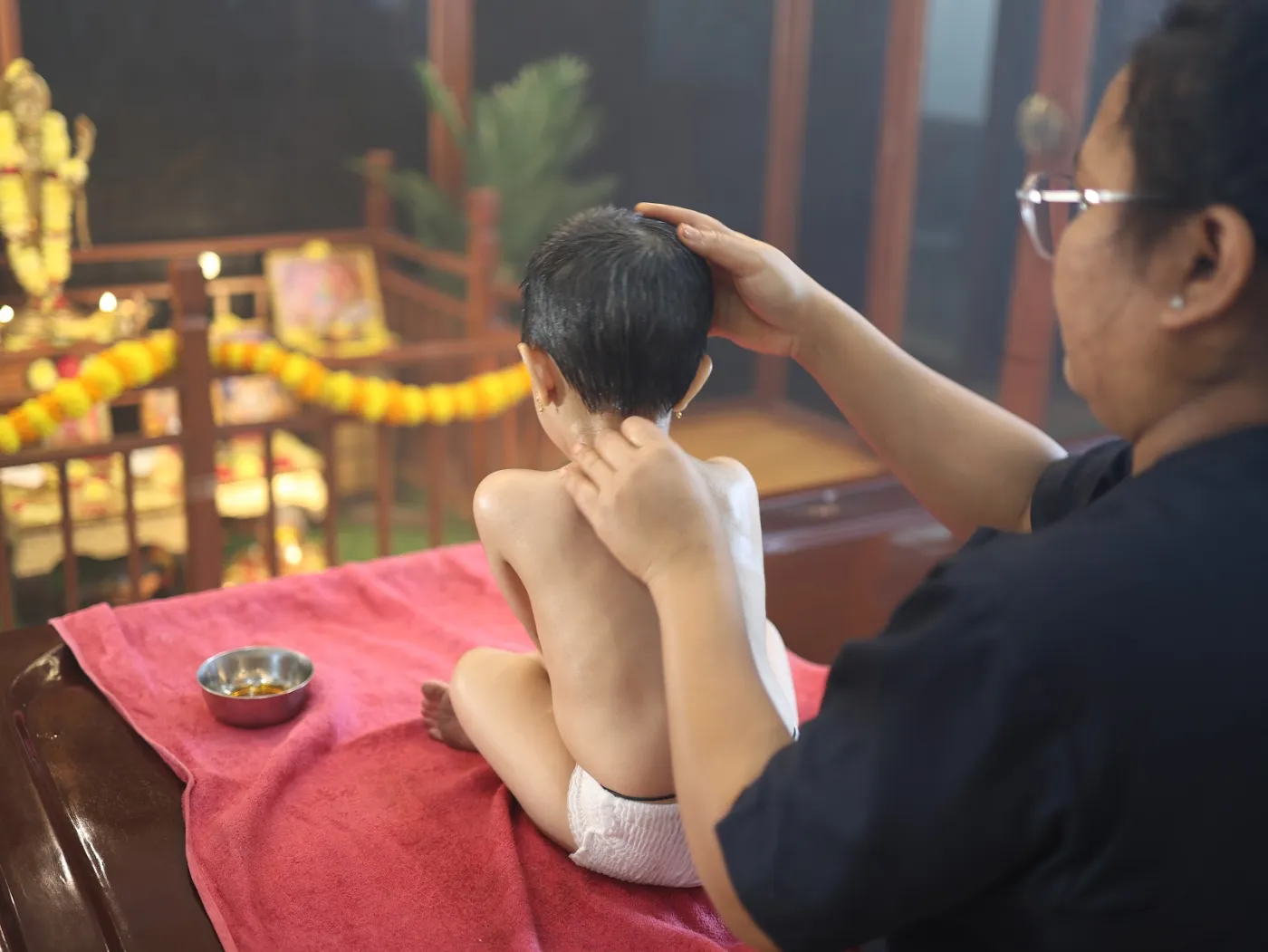
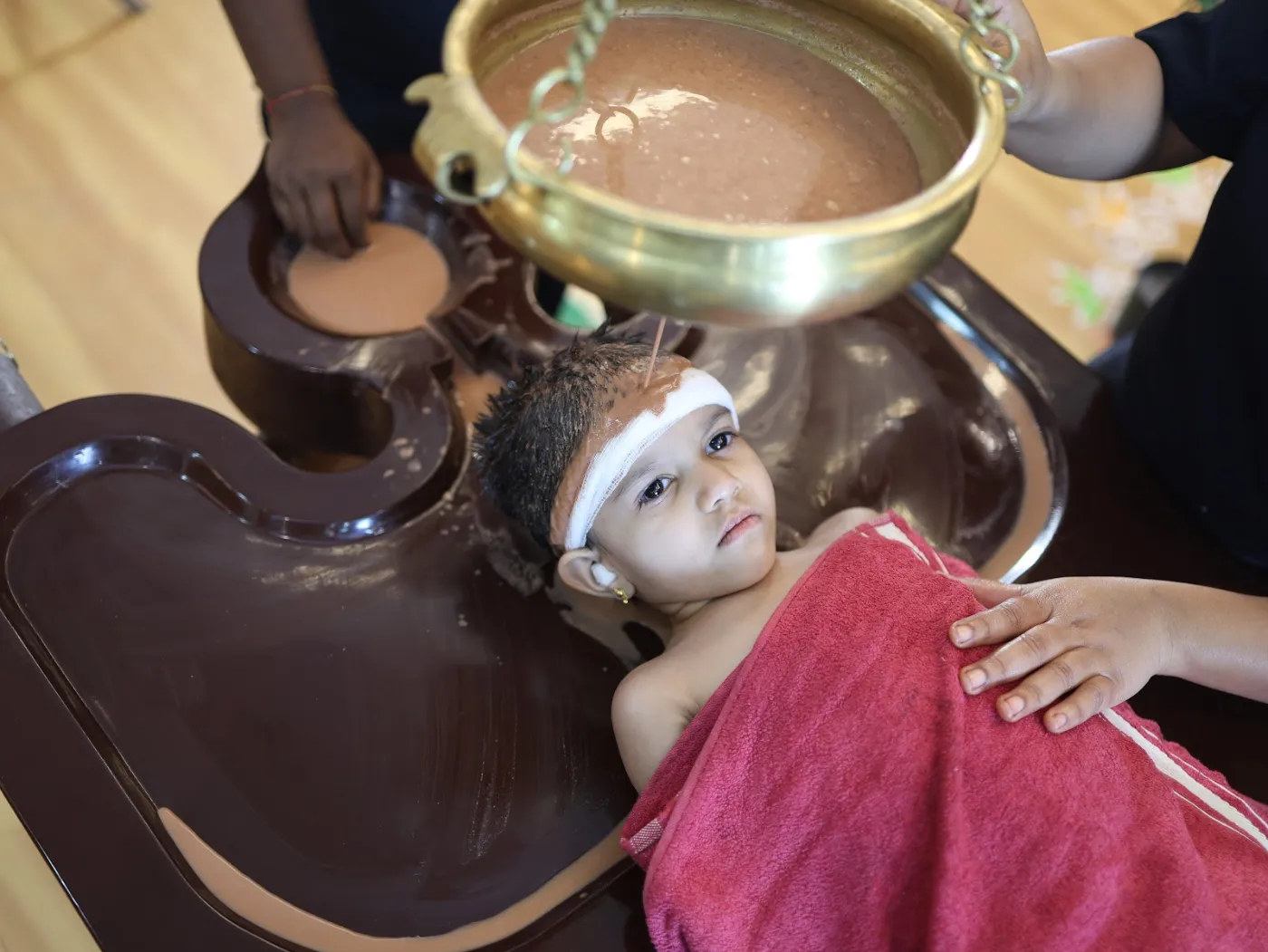

- Shirodhara or TakradharaA gentle, steady stream on the forehead, used in Ayurveda to settle a restless Prana Vata and help the mind stay calm and attentive.
- Shiro Abhyanga and ThalamWarm medicated oil or herbal paste on the head, to nourish Tarpaka Kapha and the senses.
- NasyaMedicated drops through the nose, which Ayurveda sees as the gateway to the head. Used to support Prana Vata and clear extra Kapha.
- Marma therapyGentle touch on specific points of the head and body, to help a child feel calm and settled.
- Vasti and AbhyangaTo balance Vata at its root and support the whole body.
- Customised medicinesMedicines made in our own AYUSH-licensed unit with Medhya Rasayana herbs, such as Vaakkdevi Rasayana, chosen for your child’s pattern.
This page is for general information and is not a diagnosis. All therapies and medicines are given only as advised by Dr. Santhisree Bheesetti after Nadi Pariksha. Not every child needs every therapy.
Assessment and follow-up
How we understand your child, and track progress
What we look at
- How your child responds to their name and to everyday sounds
- Which words, objects and body parts they recognise
- Whether they follow simple instructions, with and without pointing
- Whether they can follow two-step instructions
- How they answer simple questions
- How long they can listen and pay attention
- How they speak, since understanding and speaking are closely linked
- Hearing history, ear infections and any earlier hearing tests
- Nadi Pariksha, along with digestion, sleep and behaviour
If needed, we may suggest a hearing test or an assessment by a speech-language pathologist.
What we watch for together
- Responding more quickly when spoken to
- Following instructions without you needing to point
- Following two steps in a row
- Recognising more words, pictures and names
- Answering simple questions with the right kind of answer
- Listening for longer, and understanding in new places, not only at home
Each child moves at their own pace. We note every small step, and adjust the plan as your child grows.
Start today at home
Six ways to make words easier to understand
How you speak to your child can make a big difference to how much they understand.
Get down to their level
Face your child and get their attention before you speak.
One instruction at a time
Use short, simple sentences. Wait until one step is done before giving the next.
“Shoes, please.” Then: “Now the bag.”
Show as you say
Point, gesture or hold up the object while you name it.
Same words, every day
Use the same words for daily routines, so they become familiar.
“Bath time!” “Milk time!”
Turn the noise down
Switch off the TV when you talk together. Background noise makes listening harder.
Look at books together
Name the pictures, then ask your child to find them.
“Where is the dog?”
From research
What research tells us about understanding language
These studies are about hearing and how young children learn to understand words in general. They are not studies of Ayurvedic treatment.
In a study of 150 children with hearing loss in the USA, those whose hearing loss was found by 6 months of age had better language than those found later.
In a study of families in the USA, toddlers who heard more talk directed at them became quicker at understanding familiar words and had larger vocabularies by age 2. Talk they only overheard was not linked to vocabulary.
In a study of 50 late-talking toddlers in Italy, difficulty understanding sentences at about 28 months was an early sign of language difficulties that lasted. This is why we check understanding, not only speaking.
- Yoshinaga-Itano C et al. Language of early- and later-identified children with hearing loss. Pediatrics. 1998. doi:10.1542/peds.102.5.1161
- Weisleder A, Fernald A. Talking to children matters: early language experience strengthens processing and builds vocabulary. Psychol Sci. 2013. doi:10.1177/0956797613488145
- Chilosi AM et al. Which linguistic measures distinguish transient from persistent language problems in Late Talkers from 2 to 4 years? Res Dev Disabil. 2019. doi:10.1016/j.ridd.2019.03.005
Questions parents ask
Receptive delay: your questions
My child hears the TV from another room. Can it still be a hearing problem?
It can. A child may hear some sounds clearly and others poorly, and hearing can come and go with colds and ear infections. A proper hearing test is the only way to be sure.
Is my child just being stubborn or naughty?
Often not. A child who doesn’t understand what is expected can look as if they are ignoring you. Short, clear words with gestures can help you see what your child does understand.
Could this be Autism?
Difficulty understanding can happen on its own. But if your child also makes little eye contact, rarely responds to their name, doesn’t point to show you things, or plays in repetitive ways, please talk to us, a developmental paediatrician or a child psychologist about an Autism assessment. Read more about our Ayurvedic care for Autism.
Should we stop speech therapy if we start Ayurvedic care?
No. We don’t offer speech therapy ourselves, and we encourage you to continue it. The two can go hand in hand.
Can we consult from another city or country?
Yes. We offer online consultations across India and for families abroad. Medicines are currently delivered within India only.
Speech & language family
Other speech and language difficulties
These difficulties can occur independently or coexist. A comprehensive assessment helps identify the child’s individual communication profile.
#DontWaitStartEarly
Help your child make sense of words
Meet Dr. Santhisree Bheesetti at our clinics in Hyderabad, Visakhapatnam, Bengaluru or Delhi, or online from anywhere.