
Speech delay › Expressive language delay
“My child understands so much, but the words just don’t come.”
Speech & language family
Expressive Language Delay in Children
Your child follows what you say, brings the ball when you ask, and laughs at the right moments. But the words don’t come, or come slowly, a few at a time. This may be a sign of expressive language delay, where a child’s ability to express thoughts, needs and feelings develops more slowly than expected for their age. Dr. Santhisree Bheesetti, Ayurvedic Child Neurocare Expert with 15+ years of experience, supports children like yours, and their families, on the way to words.
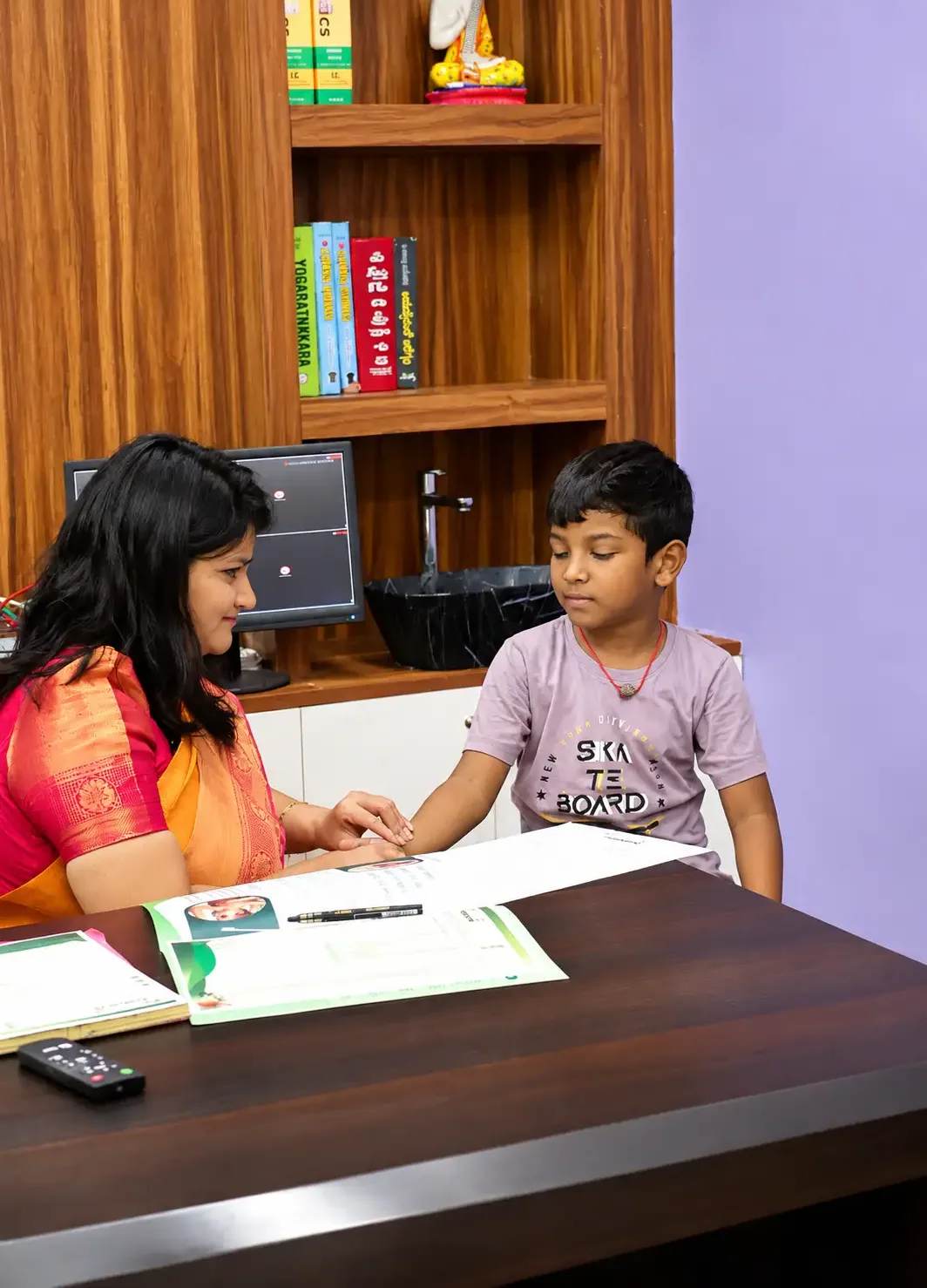
Signs parents often notice
Understanding often runs ahead of speaking
Expressive language is how a child puts thoughts into words. In predominantly expressive language delay, a child’s ability to understand language may be relatively stronger than their ability to express thoughts, form sentences and communicate needs.
Follows simple instructions, like “bring your shoes”
Uses fewer words than other children of the same age
Pulls your hand or points, instead of asking in words
Speaks in single words when others use short sentences
Struggles to find the right word, or uses “that” and “this” for everything
Gets frustrated or cries when you don’t understand what they want
Noticing a few of these signs does not mean your child has expressive language delay. Many of them overlap with other speech and language difficulties, and only a proper assessment can tell what is going on, with us, a developmental paediatrician or a speech-language pathologist.
Why it happens
Why do some children talk later?
Often there is no single reason. These are some of the things that can play a part, and more than one may be involved.
How language develops
In some children, the brain simply takes longer to put words and sentences together.
Family history
Late talking often runs in families. A parent or relative may have started talking late too.
Hearing problems
Even mild hearing loss, or repeated ear infections, can make it harder to learn words.
Linked developmental conditions
Speech delay can be one part of conditions such as Autism or global developmental delay.
Each child’s own story
Other things in your child’s health and growth can also play a part. This is why we look at the whole child.
Traditional Ayurvedic interpretation
In traditional Ayurvedic interpretation, delayed expression of speech is linked mainly to the functions of Udana Vata and Kapha. This is explained further down this page.
When to act
What most children say by this age
18 months
Try to say three or more words besides “mama” and “dada”, and point to show you things.
Get your child checked ifYour child has no words yet, or doesn’t point or wave.
2 years
Put two words together, like “more milk”, and point to things in a book when asked.
Get your child checked ifYour child isn’t joining two words, or has very few words.
3 years
Have short back-and-forth conversations, ask “what” and “where”, and say what is happening in a picture.
Get your child checked ifYour child speaks only in single words or short phrases.
Please have your child checked soon, by us, a developmental paediatrician or a speech-language pathologist, if your child:
- Has lost words or skills they used before
- Does not respond well to sounds or to their name
- Uses very few gestures, like pointing, waving or nodding
- Has difficulty understanding what is said
- Is also behind in other areas, such as movement or play
A hearing test is also important.
Milestones adapted from the CDC’s “Learn the Signs. Act Early.” programme. Every child with a speech delay should have a hearing test. Read about language regression.
Traditional Ayurvedic interpretation
When words are slow to come out
In Ayurveda, a word travels a path before it is spoken. The senses take it in, the mind understands it, and then Udana Vata pushes it out through the voice. From an Ayurvedic perspective, expressive language difficulties may be interpreted through the functional relationship between Prana Vata, Udana Vata, Sadhaka Pitta, Tarpaka Kapha and Bodhaka Kapha. When a child understands more than they can say, the early steps are often stronger, and the harder part tends to be near the end.
Udana Vata Daurbalya
When Udana Vata is weak or unsteady
- Starts speaking on their own less often
- Effort to speak comes and goes from day to day
- Often a light, restless child, with dryness, poor sleep or constipation
- Finds it hard to keep a conversation going
Care focus: nourishing and steadying Vata.
Kaphavrita Udana Vata
When heavy Kapha covers Udana Vata
- Slower to start speaking
- The mouth may seem less active, or may dislike certain food textures
- Extra saliva or drooling in some children
- Often a quieter child, slow to warm up, with frequent colds or a heavy feel
Care focus: clearing Kapha and freeing Udana Vata.
These are general patterns from traditional Ayurvedic interpretation, not a way to judge your own child. Many children show a mix of both. Through Nadi Pariksha, developmental history, clinical observation and assessment of digestion, sleep, sensory responses and behaviour, we develop an individualised Ayurvedic care plan.
The 11 Functional Brain Systems Framework
Speech leans on other systems
Dr. Santhisree’s 11 Functional Brain Systems Framework looks at the whole child. These are the systems most closely linked to expressing language.
Not every child has difficulty in all of these. The assessment shows which systems need support in your child.
How we help
Helping the words come out
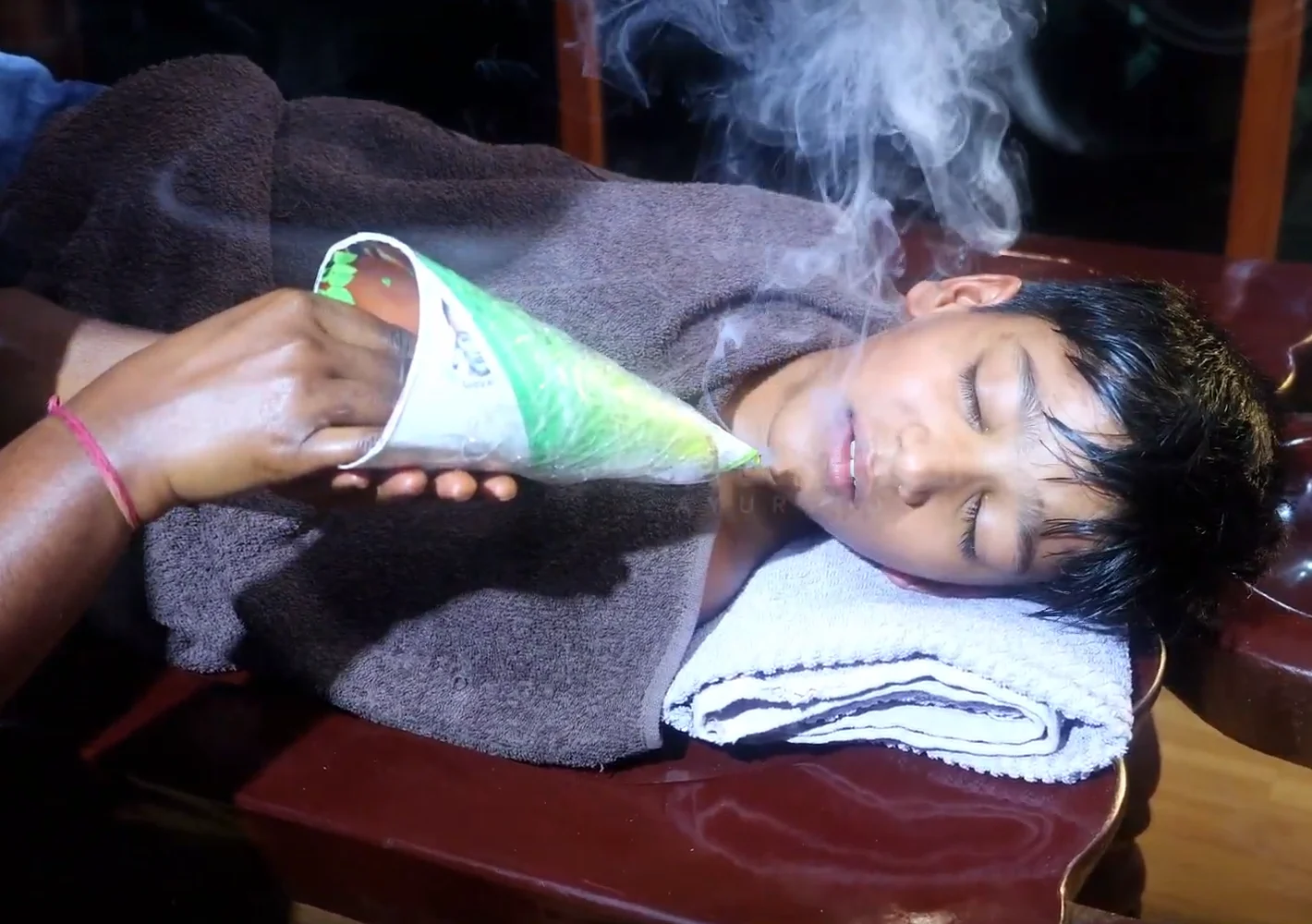
- NasyaMedicated drops or gentle herbal smoke through the nose. Ayurveda sees the nose as the gateway to the head, and uses Nasya to support Prana and Udana Vata and to clear extra Kapha.
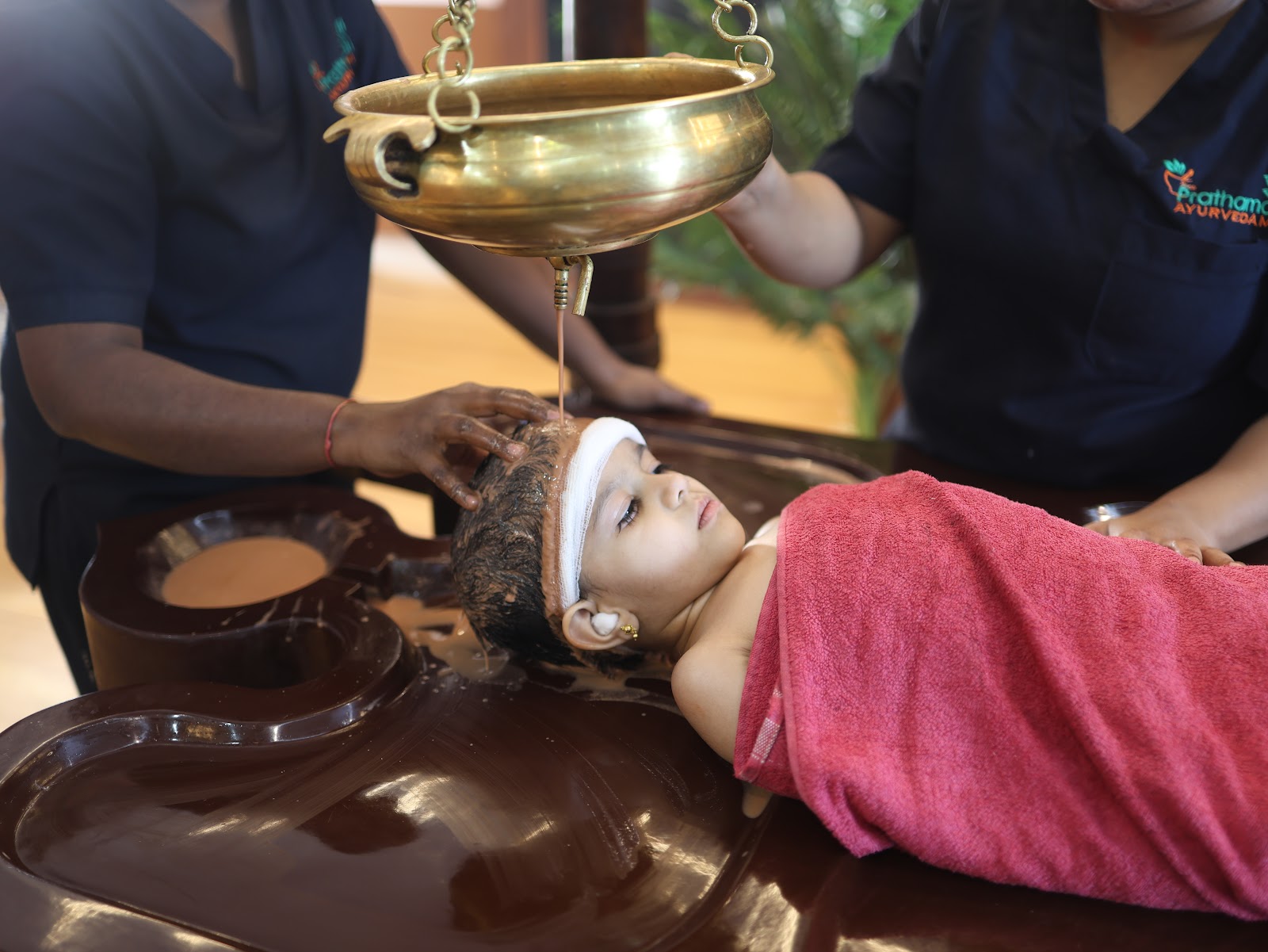
- Shiro Abhyanga and ThalamWarm oil or herbal paste on the head to nourish the senses and settle the mind.
- Shirodhara or TakradharaA steady stream on the forehead to calm a restless, scattered Vata.
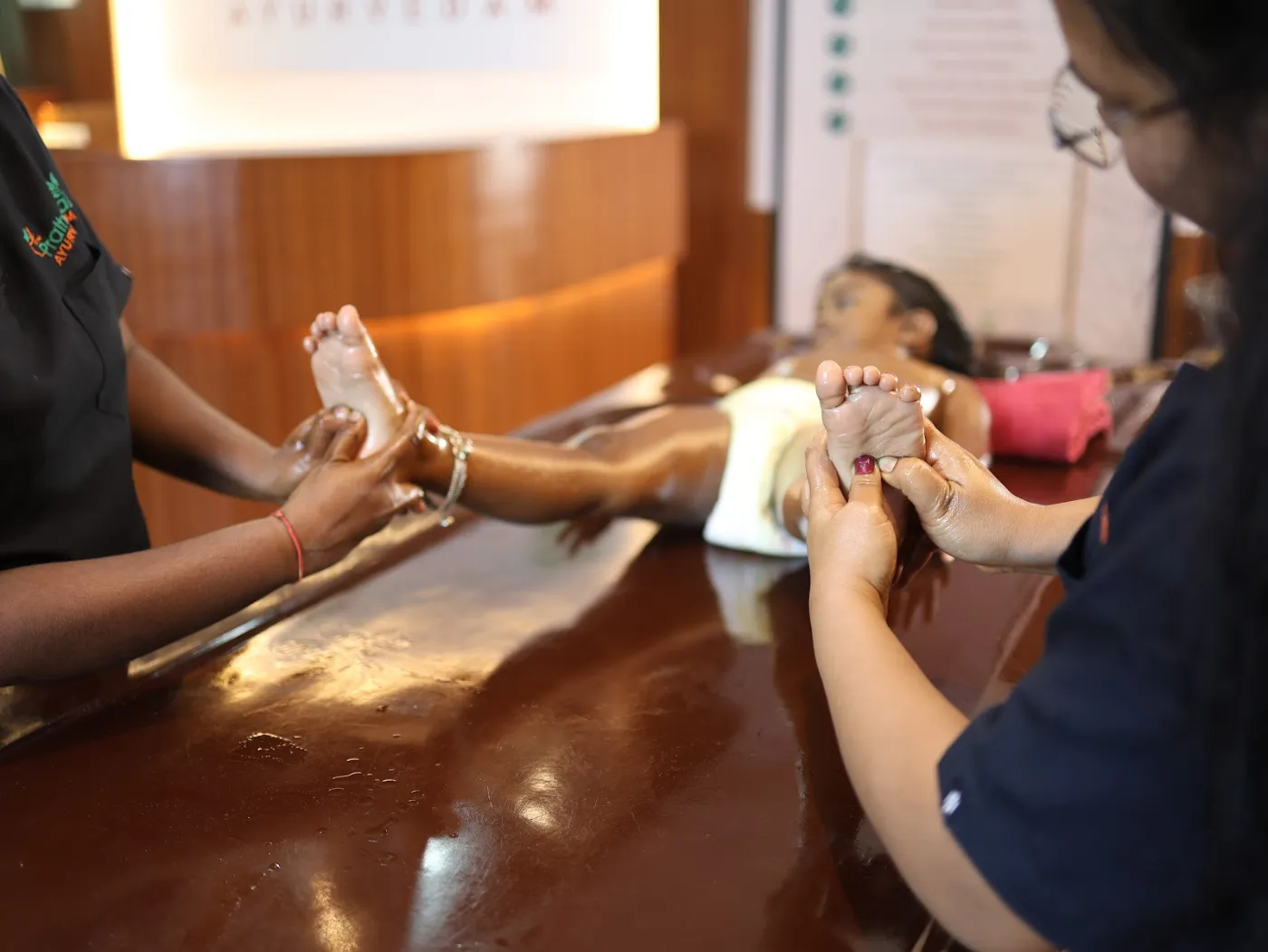
- Vasti and Abhyanga with MarmaTo balance Vata at its root and strengthen the whole body.
- Customised medicinesMedicines made in our own AYUSH-licensed unit with Medhya Rasayana herbs, such as Vaakkdevi Rasayana, chosen for your child’s pattern.
This page is for general information and is not a diagnosis. All therapies and medicines are given only as advised by Dr. Santhisree Bheesetti after Nadi Pariksha. Not every child needs every therapy.
Assessment and follow-up
How we understand your child, and track progress
What we look at
- When your child said their first meaningful word
- How many words they use on their own, without prompting
- Whether they copy words and sounds
- How well they understand what is said to them
- How long their sentences are
- How much they want to communicate, through pointing, gestures or pulling your hand
- Whether they struggle to find the right word
- Hearing history and any ear problems
- Nadi Pariksha, along with digestion, sleep and behaviour
If needed, we may suggest a hearing test or an assessment by a speech-language pathologist.
What we watch for together
- New words your child says on their own
- Asking for things with words
- Needing less prompting from you
- Joining two words together
- Longer, fuller sentences
- Talking in more places and with more people, not only at home
Every child moves at their own pace. Small steps are noted and celebrated, and the plan is adjusted as your child changes.
Start today at home
Six habits that invite words
Parents are a child’s best speech partners. Small changes in how you talk and play make a real difference.
Pause and count to five
After you ask or offer something, wait quietly. Give your child time to try.
Add one word to theirs
If your child says a word, say it back with one more word.
Child: “Ball.” You: “Red ball!”
Offer two choices
Hold up two things and name them. A choice is easier than an open question.
“Banana or apple?”
Narrate your day
Describe what you and your child are doing, in short, simple sentences.
“Water. Warm water. Hands in!”
Sing, then stop
Sing a favourite rhyme and pause before the last word. Let your child fill the gap.
Fewer screens, no pressure
Keep screen time low, especially for under-twos. And avoid “Say it! Say it!”; pressure makes talking harder.
From research
What research tells us about early language development
These studies are about how young children learn to talk in general. They are not studies of Ayurvedic treatment.
two-year-olds were late in starting to talk, in a study of 1,766 children in Australia.
A review of 18 studies found that when parents are taught simple language strategies, children’s speaking and understanding improve.
In a study of 18-month-olds, each extra 30 minutes a day on a mobile device was linked to a higher chance of delayed speech. This shows a link, not proof that screens cause delay.
- Zubrick SR et al. Late language emergence at 24 months. J Speech Lang Hear Res. 2007. doi:10.1044/1092-4388(2007/106)
- Roberts MY, Kaiser AP. The effectiveness of parent-implemented language interventions: a meta-analysis. Am J Speech Lang Pathol. 2011. doi:10.1044/1058-0360(2011/10-0055)
- van den Heuvel M et al. Mobile media device use is associated with expressive language delay in 18-month-old children. J Dev Behav Pediatr. 2019. doi:10.1097/DBP.0000000000000630
Questions parents ask
Expressive delay: your questions
Everyone says boys talk late and he will catch up. Should we wait?
Many late talkers do catch up, but some don’t, and there is no way to know in advance which group your child is in. So it is better to get advice early than to wait and watch.
Could this be Autism?
Expressive delay can happen on its own. But if your child also makes little eye contact, rarely points or shows you things, doesn’t respond to their name, or plays in unusual, repetitive ways, please talk to us, a developmental paediatrician or a child psychologist about an Autism assessment. Read more about our Ayurvedic care for Autism.
Does speaking two languages at home cause speech delay?
No. Children can learn two or more languages from the start. Speak to your child in the language you are most comfortable in, and talk a lot.
Do you offer speech therapy?
No, we don’t offer speech therapy at our clinics. Ayurvedic care and speech therapy can go hand in hand, so please continue with your child’s speech therapist.
Can we consult online?
Yes. We offer online consultations across India and for families abroad. Medicines are currently delivered within India only.
Speech & language family
Other speech and language difficulties
These difficulties can occur independently or coexist. A comprehensive assessment helps identify the child’s individual communication profile.
#DontWaitStartEarly
Start your child’s journey to words
Meet Dr. Santhisree Bheesetti at our clinics in Hyderabad, Visakhapatnam, Bengaluru or Delhi, or online from anywhere.